Hello My Baby, Goodbye My Sanity: The Wild Legacy of Michigan J. Frog
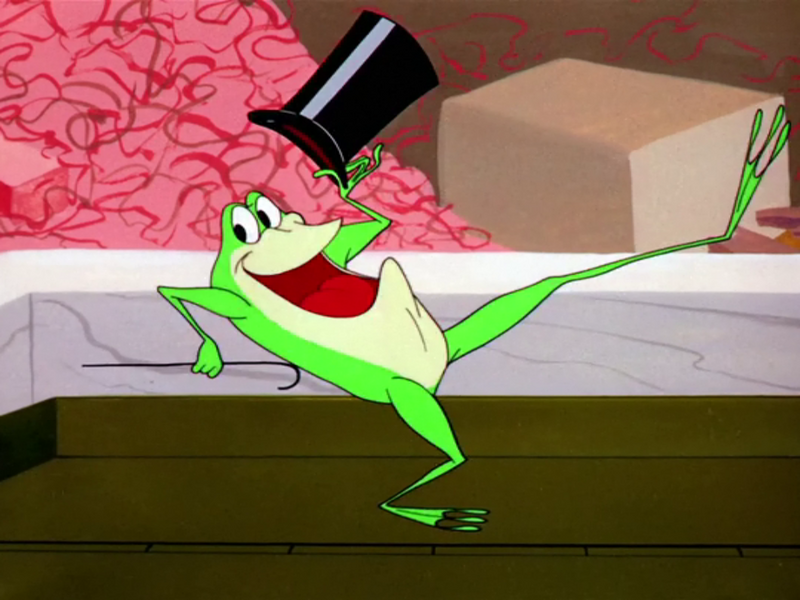
There are few cartoon characters with a history as strange, short-lived, and oddly profound as Michigan J. Frog. He’s the top-hatted, cane-swinging amphibian with a voice that could fill an opera house and an attitude straight out of vaudeville. Though he only starred in a single classic cartoon, this frog left an outsized impression on animation history—and even became the face of an entire television network.
A Star Is Hatched: “One Froggy Evening”
Michigan J. Frog made his debut in the now-iconic 1955 Merrie Melodies cartoon One Froggy Evening, directed by animation legend Chuck Jones and written by Michael Maltese. Unlike most Looney Tunes characters, Michigan never exchanged snarky barbs with Daffy Duck or outwitted Elmer Fudd. In fact, he barely says anything at all—except when he’s belting out turn-of-the-century show tunes with surprising gusto.
The cartoon tells the tale of a construction worker who discovers a singing and dancing frog hidden in a cornerstone of a demolished building. But there’s a catch: the frog performs only for him. Every time the man tries to show off the frog’s talents, Michigan reverts to regular ribbiting. The story becomes a tragicomic spiral as the man’s life unravels in pursuit of fame and fortune, while the frog smugly serenades him behind closed doors.
The Voice Behind the Ribbit
Despite his powerful singing chops, Michigan J. Frog has very little spoken dialogue. His singing voice was provided by baritone Bill Roberts, who recorded public domain hits in a smooth, rich tone that fit the frog’s theatrical personality perfectly. While Roberts never became a household name, his work helped cement Michigan’s place in pop culture as a surreal mix of golden-age entertainment and cartoon absurdity.
The genius of One Froggy Evening was how much it conveyed without relying on traditional slapstick or dialogue-heavy humor. The film has often been praised for its silent-era storytelling sensibility—largely driven by expressive animation, well-timed gags, and the frog’s booming voice.
What’s the Deal with the Songs?
The songs Michigan sings weren’t original compositions, but rather nostalgic throwbacks to early 20th-century popular music. Tracks like “Hello! Ma Baby,” “I’m Just Wild About Harry,” and “Largo al Factotum” weren’t chosen at random—they reflected a bygone era of American music hall performance.
“Hello! Ma Baby,” originally published in 1899, became the frog’s unofficial anthem. It’s a Tin Pan Alley classic that was one of the earliest songs to popularize the telephone in pop culture (“send me a kiss by wire!”). The song’s upbeat, syncopated style fit Michigan’s zany performances to a T. These songs not only emphasized the character’s outdated showbiz aesthetic but also underscored the cartoon’s theme: chasing the American Dream, only to discover it’s a cruel joke.
A Frog With Staying Power
Though he didn’t appear again until decades later, Michigan J. Frog became a symbol of timeless irony. In 1995, Warner Bros. resurrected him as the official mascot for their new television network, The WB. The image of the frog crooning “Hello! Ma Baby” in a tuxedo became a generational touchstone. Though the network eventually phased him out in 2006, his legacy lives on.
One Froggy Evening was selected for preservation in the U.S. National Film Registry in 2003—a testament to its cultural and artistic importance. Michigan J. Frog may not have the screen time of Bugs Bunny or the catchphrases of Porky Pig, but his unique blend of humor, music, and melancholy has earned him a quirky spot in animation royalty.
So next time you find yourself humming a ragtime tune out of nowhere, don’t be surprised if a smug little frog in a top hat hops into your brain. That’s Michigan J. Frog—forever singing, and forever just out of reach.